
Optical circuit switching
Solid-state and at scale.
Electronic switches are hitting their limits.
As AI models grow, the network is becoming the bottleneck. Electronic switches struggle to keep up with the bandwidth, latency, and power demands of training and inference at scale. Hyperscalers are racing to a fundamentally new switching architecture — and that architecture is optical.
Google’s public deployment of optical circuit switching at scale cut network power by 40% and cost by 30%. The economics aren’t in doubt. The remaining question is what optical technology will define the next decade.
Send light, not signals.
Routing light directly from point A to point B — rather than converting back and forth between optical and electrical at every hop — is the simplest path to the speed and efficiency AI infrastructure needs.

Near-zero latency
No round-trip through electronics. Photons travel end to end at the speed of light.
Near-zero power
Optical switches don’t consume power per packet. Less heat, less cooling, lower TCO.
Lower cost per port
High integration density and software-defined calibration drive port cost down at scale.
Upgradable bandwidth
Optical fabric is transparent to data rate. Upgrade the endpoints; keep the network.
Today's optical switches are mechanical.
Current state-of-the-art OCS systems rely on MEMS — micro-electromechanical mirrors that physically tilt to route light. They work, but they don’t scale.
- Mechanical, with limited reliability over millions of cycles
- Small steering angles drive large system size and high cost per port
- Slow switching speed limits workload flexibility
- Expensive real-time calibration and assembly
Hyperscale networks need a switch that’s solid-state, fast, scalable, and built like a semiconductor.

Switching at semiconductor scale.
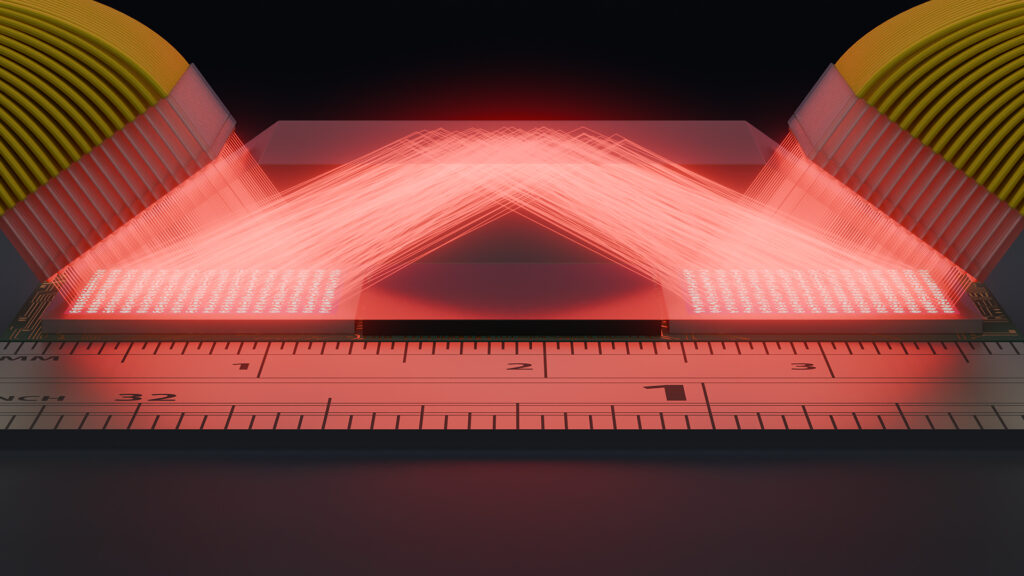
By mapping pixels to ports in software, an LCM-based switch makes every port independently programmable — in position, size, steering, and lensing. The result is a switch that’s solid-state, ultra-compact, scalable to 10k × 10k, and built like a chip.
Solid-state
Scalable port count
Software-defined ports
Ultra-low insertion loss
Compact
Manufacturable
50 µs
10k × 10k
From compact to hyperscale.
Two reference architectures cover both ends of the AI infrastructure stack: scale-up inside the rack, scale-out across the cluster. Both use the same Lumotive LCM optical engine — just tiled, packaged, and scaled differently.

Architecting the next AI data center?
We’re partnering with hyperscalers and infrastructure OEMs on OCS programs at every scale — from rack-level scale-up to 10k × 10k hyperscale fabrics.