
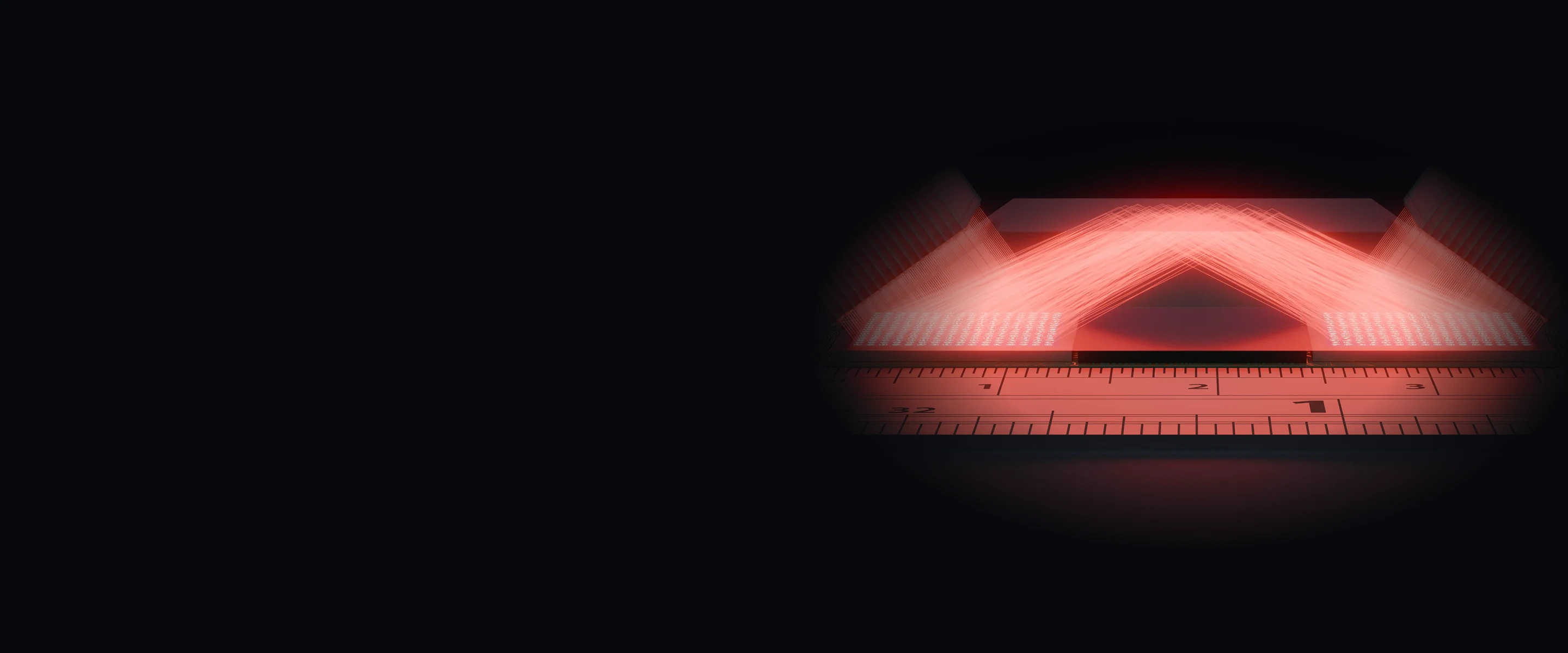
Near-zero latency
No round trip through electronics. Photons travel end to end at the speed of light.
Lumotive Connect
Solid-state and at scale.
Optical matters now
As AI models grow, the network is becoming the bottleneck. Electronic switches struggle to keep up with the bandwidth, latency, and power demands of training and inference at scale. Hyperscalers are moving to a fundamentally new switching architecture, and that architecture is optical.
Google’s public deployment of optical circuit switching at scale cut network power by 40% and cost by 30%. The economics are clear. The remaining question is which optical technology will define the next decade.
Routing light directly from point A to point B, rather than converting between optical and electrical at every hop, is the simplest path to the speed and efficiency AI infrastructure needs.
No round trip through electronics. Photons travel end to end at the speed of light.
Optical switches consume no power per packet. Less heat, less cooling, lower TCO.
High integration density and software-defined calibration drive port cost down at scale.
The optical fabric is transparent to data rate. Upgrade the endpoints; keep the network.
Why MEMS cannot scale
Current state-of-the-art OCS systems rely on MEMS: micro-electromechanical mirrors that physically tilt to route light. They work, but they do not scale.
Hyperscale networks need a switch that is solid-state, fast, and scalable.
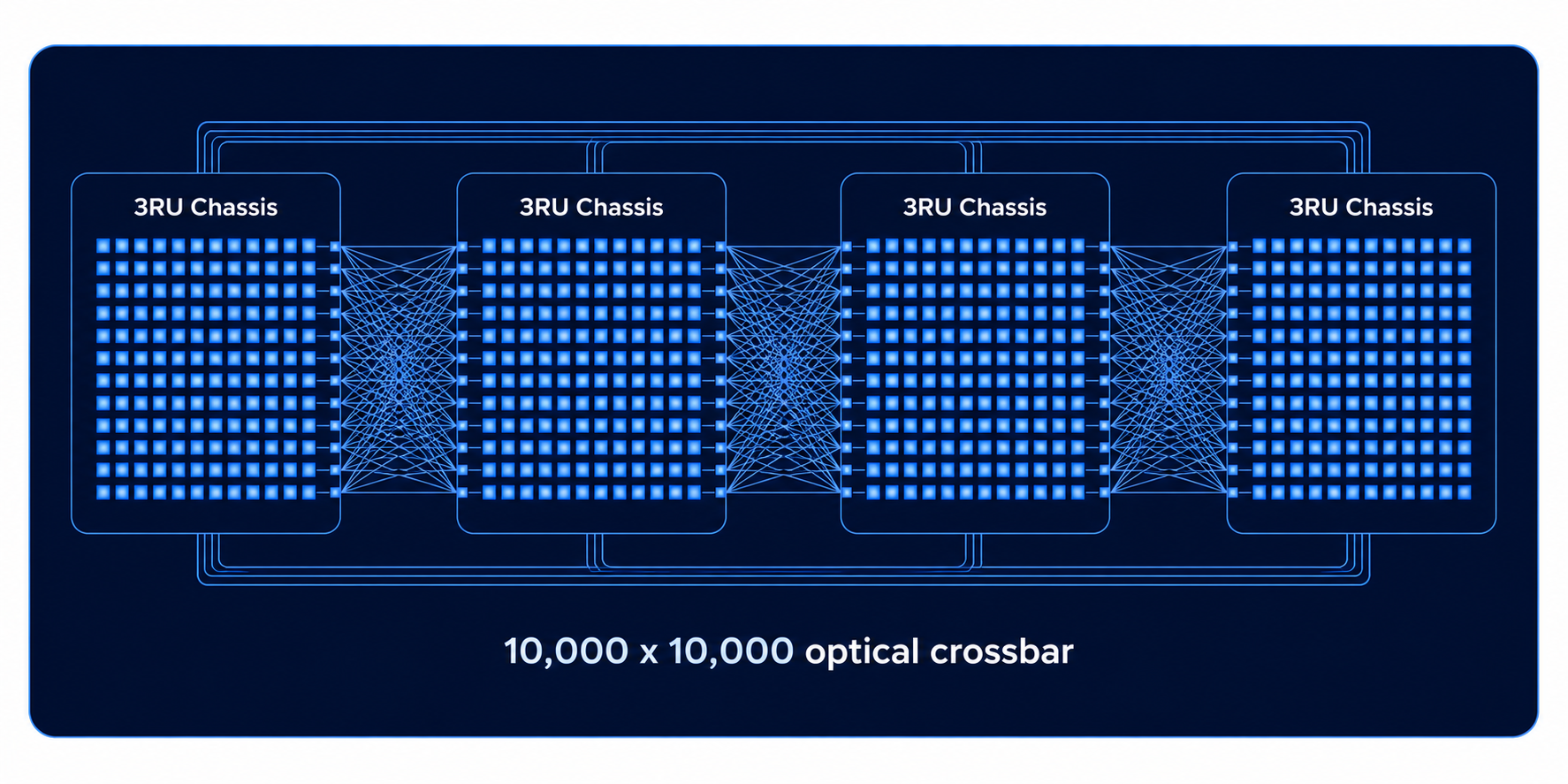
By mapping pixels to ports in software, an LCM-based switch makes every port independently programmable in position, size, steering, and lensing. The result is a switch that is solid-state, ultra-compact, and scalable to 10k × 10k.
No moving parts. No drift. No periodic recalibration. Built to outlast the network it sits in.
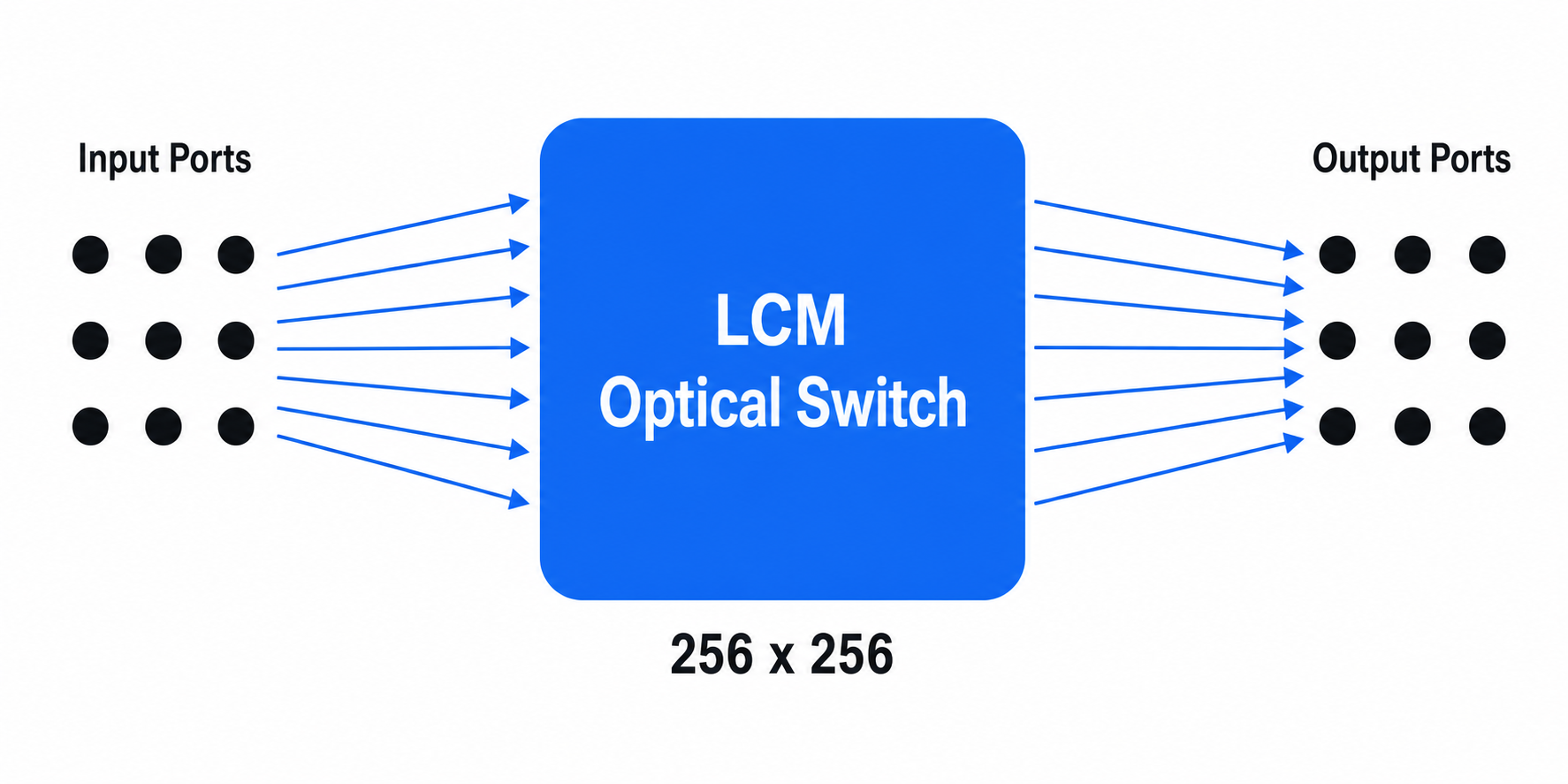
From a 256 × 256 compact form factor to 10,000 × 10,000 in a 3RU chassis, without redesigning the optics.
Pixels map to ports in software. Every port’s position, size, steering, and lensing is independently programmable.
1–2 dB, independent of port count.
A 256 × 256 reference design fits in 4 × 3 × 2 cm³, smaller than your phone.
Standard, well-established CMOS nodes and LCoS packaging, scalable to hyperscale volumes.
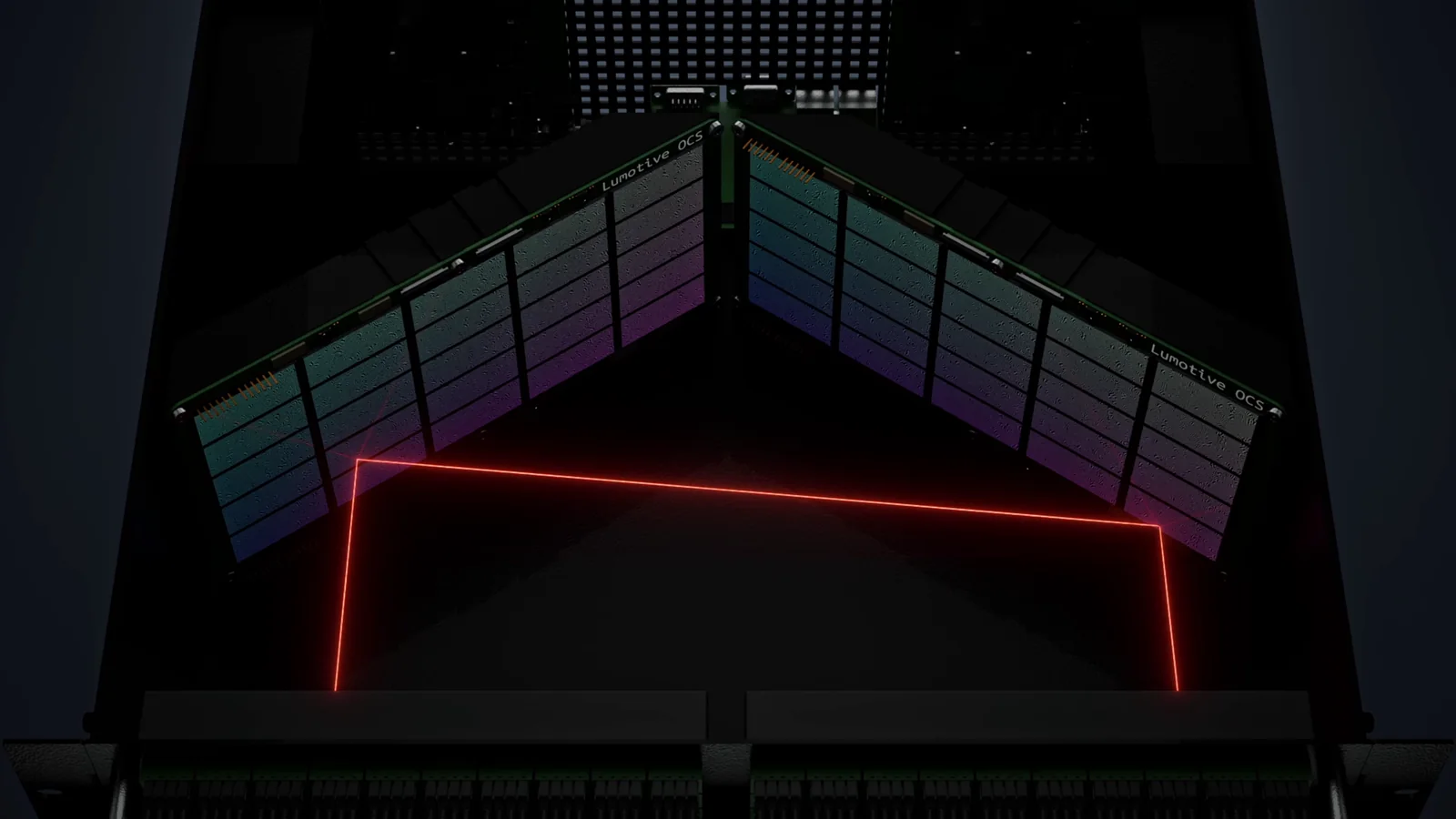
Technology foundation
We have demonstrated the world’s first programmable 2D photonic beamforming chip. Steering light across two axes in one semiconductor device is the path to the high-port-count switching AI data centers need.
Two reference architectures cover both ends of the AI infrastructure stack: scale-up inside the rack, scale-out across the cluster. Both use the same Lumotive LCM optical engine, tiled, packaged, and scaled differently.
Use cases

Optical circuit switching for scale-up inside the rack and scale-out across the cluster.

Solid-state beam control for satellite, airborne, and terrestrial free-space optical links: electronic pointing and tracking, with no gimbals or moving mirrors.
We are partnering with hyperscalers and infrastructure OEMs on OCS programs at every scale, from rack-level scale-up to 10k × 10k hyperscale fabrics.