

Multiple Returns
See through dust and rain to the object behind.
Sense · Automotive
LCM-based lidar covers 180° from a single sensor, with regions of interest at up to 900 Hz: a programmable safety cocoon around the vehicle.
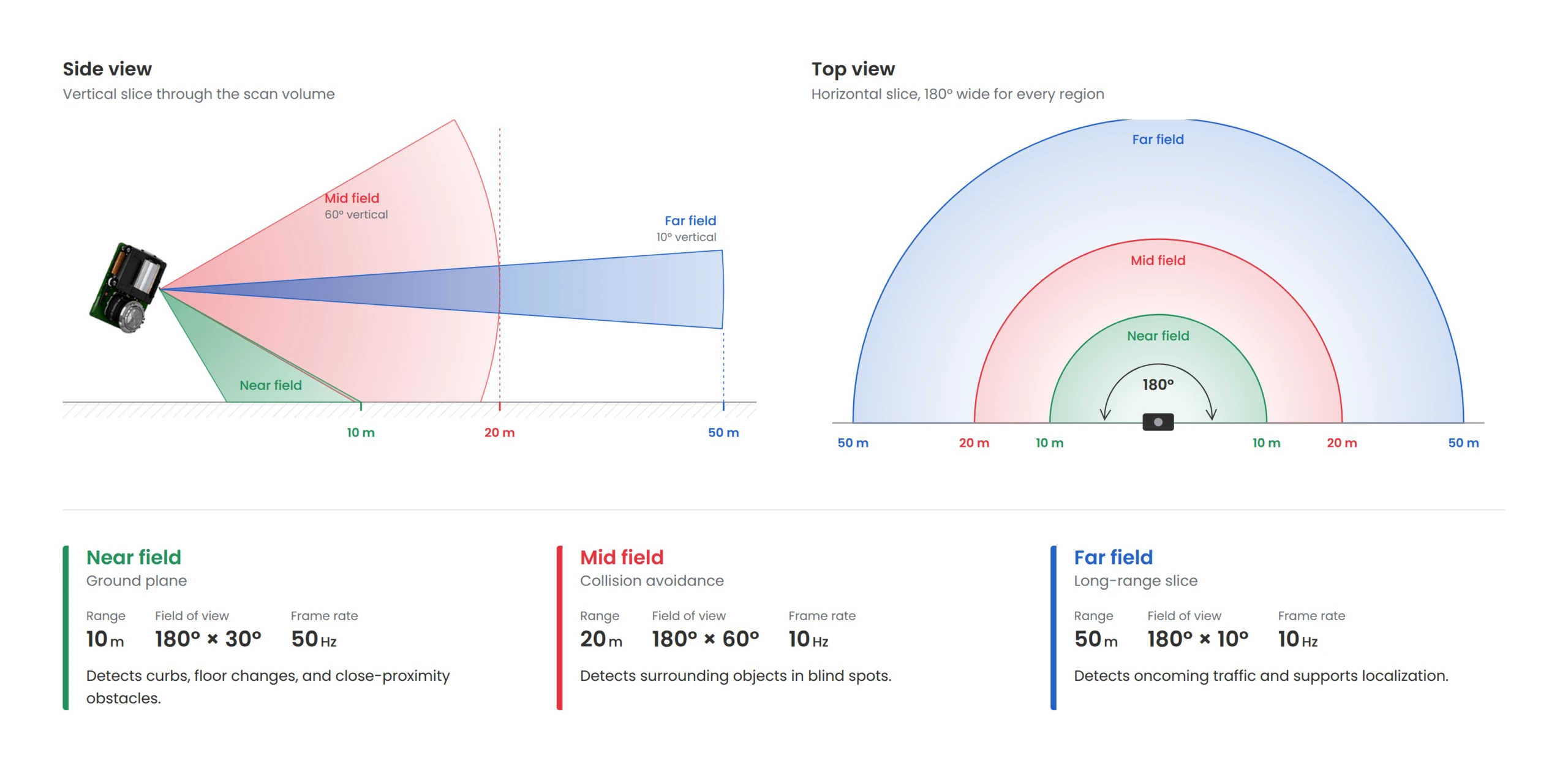
Swipe to view the full diagram
Safety cocoon
Wide-FOV LCM-based dToF sensors at the corners create continuous near-field coverage. Software decides where to look harder: a pedestrian at the curb, a bollard behind the bumper, a cyclist alongside.
Surround sensing today
Too many sensors
Covering the area around a vehicle takes several narrow-FOV sensors or a mechanical spinner.
Cost and integration
Every added sensor brings more cost and more integration work.
Near-field blind spots
Gaps close to the vehicle, exactly where pedestrians, cyclists, and obstacles appear during parking and low-speed maneuvers.
With LCM
180° and wider
Field of view per sensor.
ROIs at up to 900 Hz
For fast-moving objects.
Solid state
No moving parts.
Layered coverage
Zones at roughly 10 m, 20 m, and 50 m.
Industry first
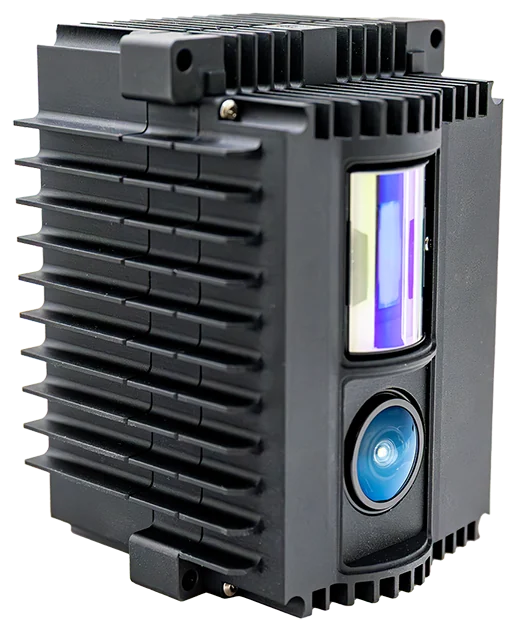
By steering light electronically at semiconductor speed, LCM pushes dToF sensors past the limits of mechanical scanning and fixed-channel VCSEL arrays. Full 180° horizontal coverage removes blind spots in safety-critical applications.
Field tested
Outdoors, the sensor has to see past dust, rain, sunlight, and glare. LCM gives you several ways to do it, all in software.
See through dust and rain to the object behind.
A low-power pulse in the same scan keeps bright targets sharp and dark targets visible.
Concentrate the beam where it matters for more signal per pixel.
Integrate longer on far or dark targets.
System-level optics minimize stray and ambient light.
Near-field coverage around large vehicles and trailers.
Agriculture, construction, and mining machines working near people.
Sidewalk robots and quadrupeds in mixed traffic.
Share your vehicle platform and coverage targets. We will map the sensor layout with you.